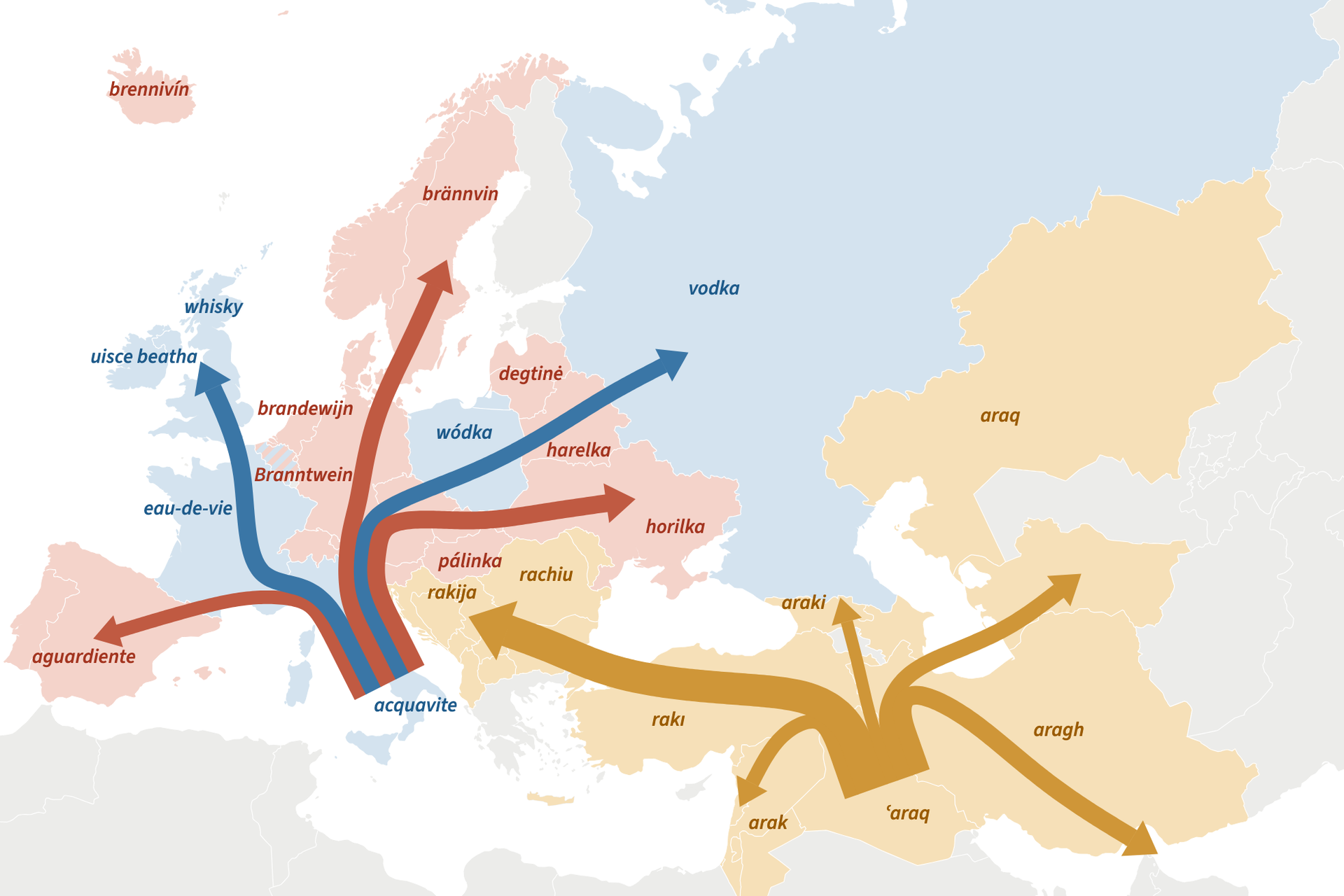
Most countries distil fermented fruit, grains or other products to make a strong alcohol, whether that be a Russian vodka, a Spanish aguardiente or a Serbian rakia made from plums. But did you know the names mostly trace back to one source, the distillers of the Arabic world, and split into three branches as they spread around the globe? As you’ll see from the map, what we call our spirits is usually based on water, sweat or burning.
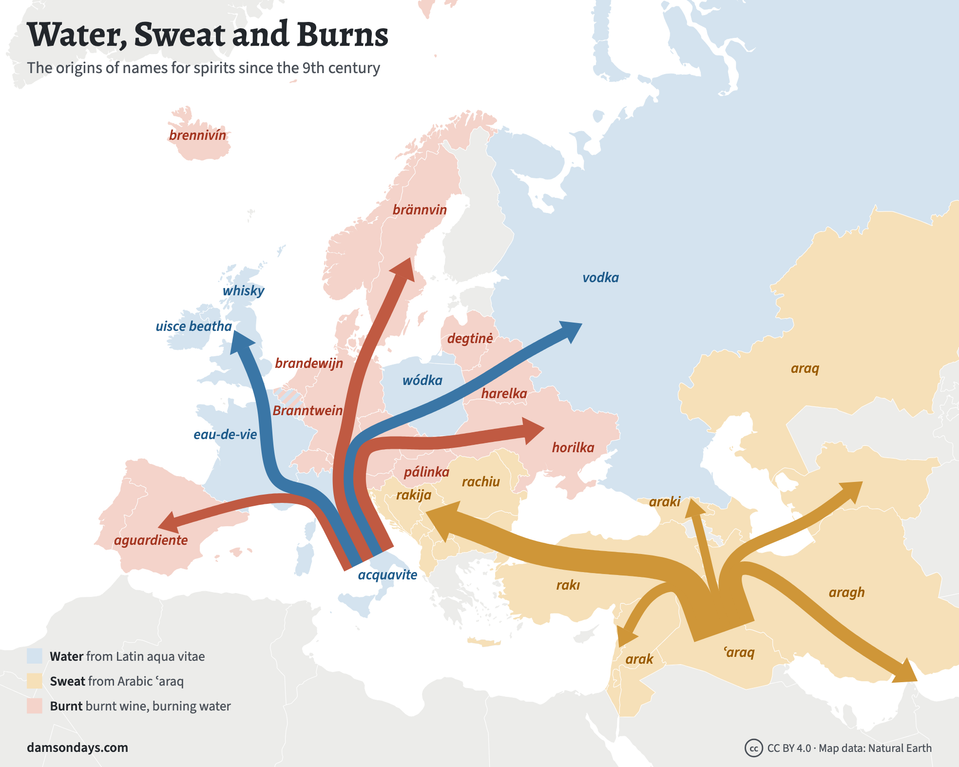
Countries left grey use words from outside the three families, such as Greek tsipouro (from grape pomace) and Finnish viina (from “wine”). The colours show each country’s traditional word; many now also use a modern one, like German Schnaps.
Sweat
Our story begins with the famous philosopher Al-Kindi, who lived in Baghdad during the 800s, and developed ideas in fields all the way from mathematics and cryptography to music, zoology and even earthquakes. One of his many interests resulted in the Book of the Chemistry of Perfume and Distillations, and this is one of the earliest sets of detailed recipes for distilling (mainly perfumes and medicines). ʿAraq means “sweat” in Arabic, and it is said that the drops condensing on a cool distillation head look like beads of sweat. As people who distilled wine used the same techniques, they called the resulting drink ʿaraq. This wasn’t the first distillation; we’d need to go back to the Greek-speaking alchemists of Alexandria, in Roman Egypt, who were using stills from the first century AD. But this was the start of a bigger movement that gradually spread all over the world.
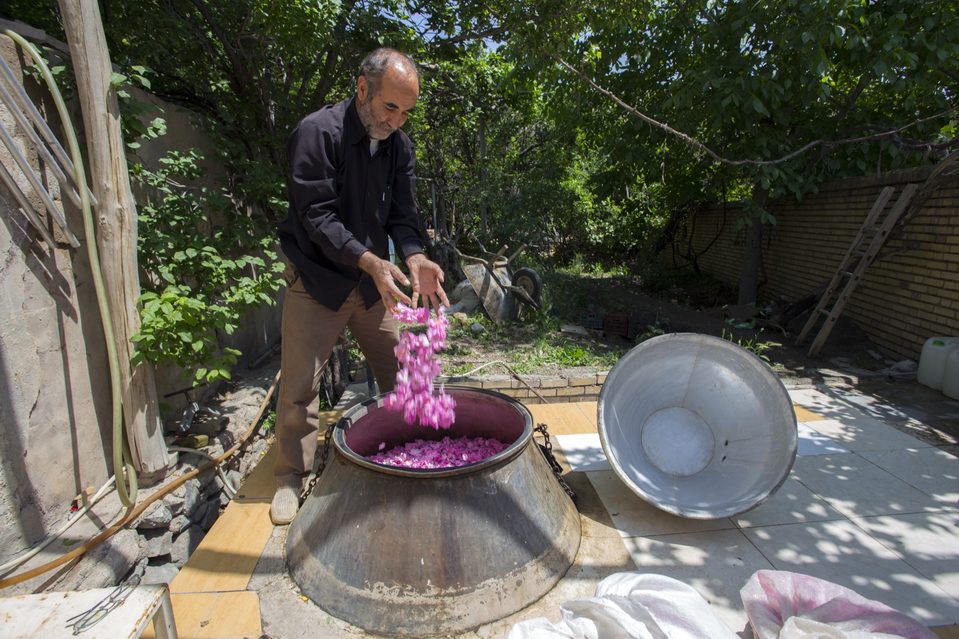

We can see how the same word gradually spread both east and west from its origins in what would be present day Iraq. In Iran it is still used for remedies made by distilling plants, like mint water (aragh-e na’na) and orange blossom water (aragh-e bahar-narenj). But elsewhere the word is associated with strong spirits made with whatever was to hand: grapes, dates, palm sap, rice, sugar cane, even milk. So we have the Arabic arak, a clear grape spirit flavoured with aniseed that turns cloudy when you add water, Mongolian arkhi, distilled from fermented milk, and Korean arak-ju around Kaesong, the old capital from the time of Mongol rule, where it’s still the local name for soju. In the Caucasus and Central Asia it became the everyday word for vodka: araq in Azerbaijan and Kazakhstan, arak in Turkmenistan and araki in Georgia. In Malaysia you might be served arak, alak in the Philippines (in Malay and Tagalog the word has come to mean any alcoholic drink). Arrack is made from palm sap in Sri Lanka and from sugar cane molasses in Java. Arrack is also what went into the first punches. The word punch first turns up in a 1632 letter from Robert Addams, a soldier with the East India Company, wishing a colleague good luck on a trading trip from the south-east coast of India up to Bengal.
The word moved across into Turkey, and rakı was first mentioned by the Ottoman traveller Evliya Çelebi in the 1630s. The Turkish name comes from the Arabic adjective ʿaraqī, “of arak”. The first syllable fell away and ʿaraqī became rakı. Today it’s the national aniseed drink, which Turks call “lion’s milk” (aslan sütü) for the way it turns white with water. That Turkish form in turn spread further into Europe. So across the Balkans there’s rakia (or rakija), a fruit brandy made from almost any fruit but most often plums. On Crete, raki is made from the skins and pips left over from winemaking, and in Romanian rachiu is the generic word for fruit spirits.
It’s incredible to see a word based on the Arabic for “sweat” spreading for centuries to represent local spirits across a broad swathe of Europe and Asia. But in Europe it stops roughly where the Ottoman empire did, at its boundary with the Habsburg empire, and to understand that we need to go back to our Latin homework.
Water
Arabic science reached Latin Europe mainly through 12th-century translators in Toledo and Sicily, on the old frontiers with the Islamic world. In Salerno, in southern Italy, the medical school‘s Magister Salernus (a physician who died in 1167) gave one of the first Latin recipes for distilling wine, calling the result aqua ardens (“burning water”, because it would catch fire). Taddeo Alderotti, a Florentine teaching medicine at Bologna, described aqua vitae (“water of life”) from double-distilled wine in 1276, and is the first to mention a more advanced coiled condenser cooled in water, which got the spirit up to about 90% alcohol.
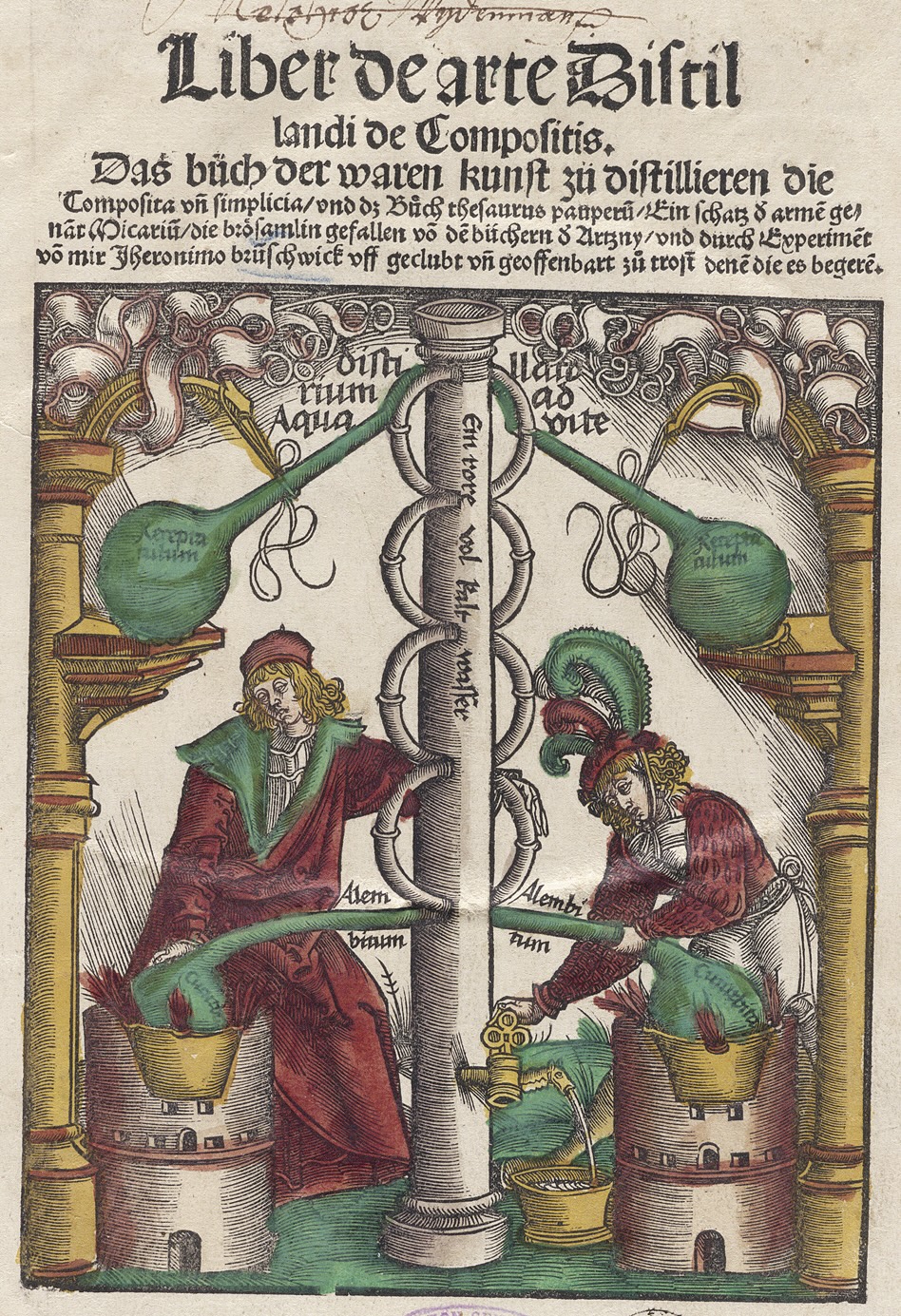

It was still medicine at this stage. Around 1300 the Catalan physician Arnau de Vilanova, teaching at Montpellier, is credited with a whole book on it. For a couple of centuries aqua vitae was made in apothecaries and monasteries and prescribed as a medicine to get the blood moving. Then in the 15th century, as the food writer Harold McGee puts it in On Food and Cooking, it was “liberated from the pharmacy and drunk for pleasure”, and German laws on public drunkenness start to mention Bernewyn and brannten Wein, “burnt wine”, the ancestors of our word brandy. As the idea spread, the Latin was simply translated: eau-de-vie in French, acquavite in Italian and later akvavit in Scandinavia. Today in France eau-de-vie means a clear fruit brandy, usually named after the fruit itself: kirsch from cherries, Poire Williams from pears, and mirabelle and quetsch from plums.
Meantime to the east, wódka (“little water”) was first recorded in Polish in 1405 in Sandomierz court records, where it referred to medicines and cosmetic cleansers, not a drink. In Russian we see it in 1533, for a medicinal drink brought from Poland. For a long time the drink itself went by other names. In Russia the grain spirit was officially “bread wine” (khlebnoe vino), while vodka meant the herbal tinctures made from it. Only in the late 19th century did vodka become the name of the drink that we know today, mostly made from grain or potatoes.
The same idea even reaches the distant north. The Irish word for water uisce comes from the earlier Proto-Indo-European wódr̥ / udéns, the same root as Russian voda and English water (so whisky and vodka are distant cousins). In Scottish Gaelic uisge beatha is “water of life”, a translation of the Latin aqua vitae. Scotland’s first written record of it is from 1494, when the king’s accounts list malt sent to Friar John Cor “to make aqua vitae”. In English it was shortened to usquebaugh, then usque/usky, then finally by the early 1700s to the whisky name we use today.
So we’ve now seen “sweat” occupy a big part of the world, with “water” (as in water of life) competing across Europe from Ireland to Russia. What about burning?
Burns
Distilling means heating a fermented liquid such as wine until the alcohol turns to vapour, then cooling the vapour so it drips out as a stronger spirit. In olden times that would have involved burning coal or wood or even peat to heat the liquid. So as well as a set of words based on “water”, in Europe we have another set based on “burning”. There’s at least two other senses of burning that are related. Alcohol is flammable. As we saw above, aqua ardens, “burning water”, was an early moniker. And tasting strong alcohol will leave you with a burning sensation.
Branntwein (the formal German word for spirits) is wine that has been “burnt” (put through the fire), and in German brennen still means “to distil” (a Brennerei is a distillery). The Dutch brandewijn also means “burnt wine”. English borrowed it as brandywine and then shortened it to brandy.
In Norway, brennevin is the everyday word for spirits like whisky, vodka, gin or akevitt. In Sweden brännvin is used for aquavit-style spirits. Iceland’s brennivín is both a general word for spirits and also the national caraway spirit, sold as Brennivín and nicknamed svarti dauði, “Black Death”.
Across the Slavic countries there’s a similar set of words, from at least two old Slavic verbs for “to burn”: gorěti and paliti. From gorěti come Ukrainian horilka, still the everyday word for vodka, Belarusian harelka (the same drink) and the Czech kořalka, “hard liquor” or “firewater”, borrowed from the Polish gorzałka, the old Polish word for vodka. From paliti (“to burn; to distil”) comes pálenka in Czechia and Slovakia, a word for any spirit but above all fruit brandy, made from plums, pears, apples, cherries, apricots and even forest berries. Hungarian borrowed it as pálinka, now a protected name for fruit brandy distilled in Hungary, and Romanian as palincă, the double-distilled fruit brandy of Transylvania. Slovenian žganje, the general word for fruit brandy, comes from yet another burning verb, žgati. And the Baltic languages have their own: Lithuanian vodka is degtinė (from degti, “to burn”) and in Latvian it’s degvīns (“burnt wine”).
Finally, consider the offshoot to the west. Spanish aguardiente and Portuguese aguardente come straight from the Latin aqua ardens, “burning water”. In Spain and Portugal they often mean a spirit made from the grape skins and pips left after winemaking. The words travelled to South America with the colonists. Colombia’s aguardiente is an aniseed spirit made from sugar cane, Ecuador’s is a plain cane spirit drunk hot, and Chile’s is made from grape skins. In Brazil, sugar cane spirit has been made since the 1530s, and Brazilian law defines cachaça as aguardente de cana made in Brazil. The burning words for drinks span the globe from Chile to Norway.
The sweep of history
From small beginnings in Iraq, with water condensing on distilling equipment like beads of sweat, we’ve seen a sizeable chunk of the world’s population take words like arak or rakia for their spirits, based on the Arabic ʿaraq for “sweat”. The Arabic learnings made their way to medieval Europe, and the same distillation process gave us aqua vitae in Latin (“water of life”), and the water-based spirit names spread across Europe, even giving us Scottish whisky. Meantime, the act of heating the distilling liquid with fire, “burning” it, diffused across the rest of Europe and beyond as a wide variety of spirit names all based on burning, from brandy in England and brennivín in Iceland to horilka in Ukraine and aguardiente in Colombia. What a marvellous tale to remember next time you take a shot of your local spirit.
So what does all this have to do with damson recipes, cocktails or any of our usual subjects on Damson Days? This year I had an unexpected crop of cherry plums from a line of mixed hedging, perhaps due to the unseasonably hot summer. There’s a recipe coming soon for a rather moreish cherry plum ginger liqueur. But it got me thinking about how cherry plums, damsons, sloes and other plums all relate, plum liqueurs across Europe, and eventually to this piece on the naming of distilled alcoholic drinks. Expect another post on plums before we get back to recipes!