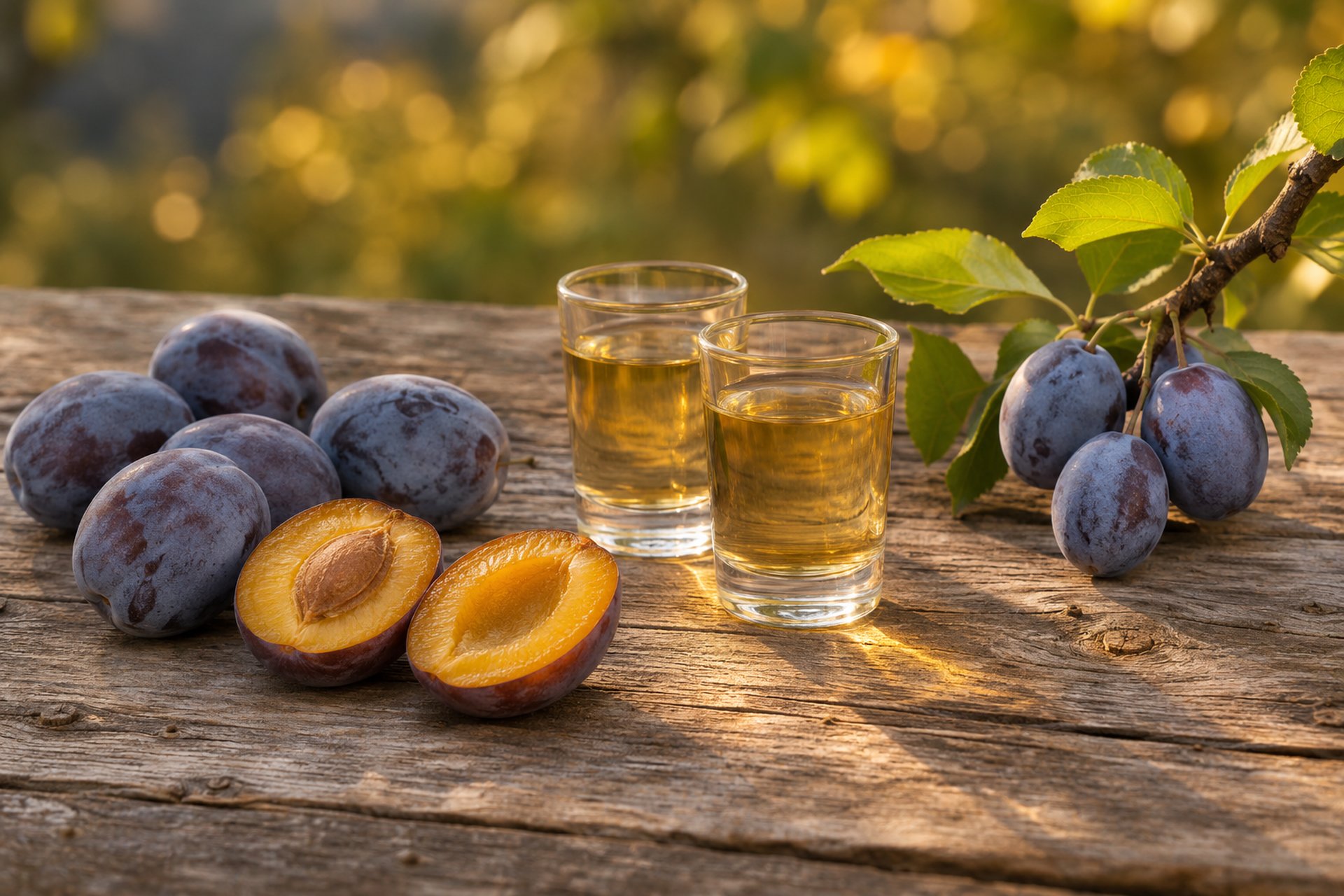
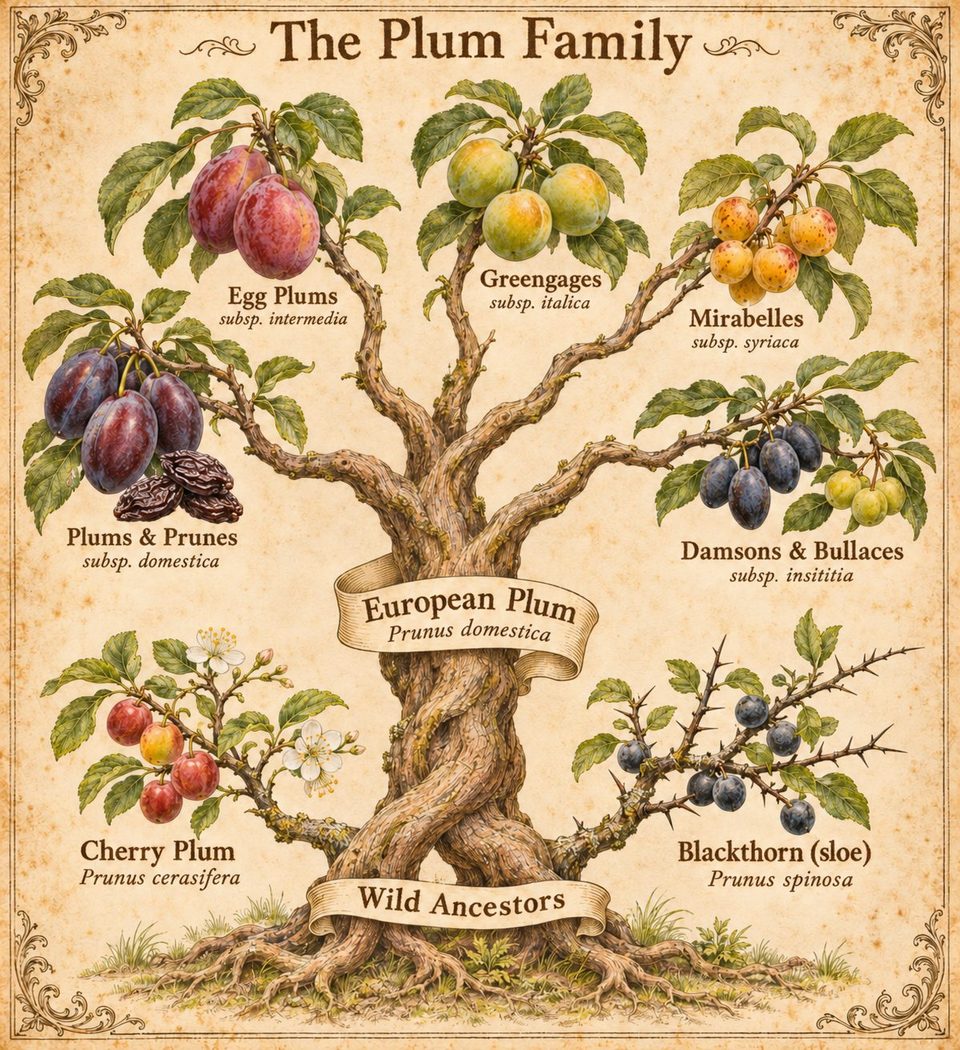
This summer I came across a pile of jewel bright little yellow fruit in the garden that I’d never seen before, dumped on the grass by a hedge like an offering. The weather had been unusual, scorching hot with very little rain, and perhaps that had prompted this hedgerow plant to produce fruit for the first time. A bit of research determined these were ripe cherry plums. So now I had both damsons and cherry plums in the garden. How do they fit together among the broader plum family?
I’ve always known that damsons and sloes are used in similar ways and can make similar recipes and drinks. Sloe gin and damson gin are close siblings. I’ve made a very successful damson patxaran but patxaran is traditionally made with sloes. However, rather than being siblings in the family tree, the current view is sloes (that come from the wickedly spiny blackthorn bush) crossed with cherry plums, and they became the ancestors for both the juicy, eating plums and the wilder damsons and bullaces.
People have been eating these fruit for a very long time. Ötzi the iceman had a sloe with him when he was shot in the back with an arrow, high in the Alps, over 5,000 years ago (Ötzi is Europe’s oldest natural mummy). Today Serbia grows 87kg of plums a year for every adult, and distils most of them into potent plum brandy. How did a sour little hedgerow fruit end up as a national drink all over the Balkans?
Origin story
The European plum probably arose south of the Caucasus mountains, around present day Georgia, Armenia and Azerbaijan. Wild sloes and bullaces were part of our diet all the way back to prehistoric times. We know that, after the last ice age, hunter gatherers in Britain ate sloes, as the stones have been found at Mesolithic sites (from roughly 11,500 to 6,000 years ago). An Iron Age village uncovered at Glastonbury, lived in from about 185 to 20 BC, had “two wheelbarrows full of sloe-stones”. It’s pretty clear our forebears loved their sloes, even before they knew how to make sloe gin.
By the time of the Romans, the number of plum varieties had proliferated. The Roman writer and naturalist Pliny the Elder writes in about AD 77 about “a vast number of varieties” of plum, including black, white, “barley” and Armenian plums, and plums grafted onto apple and almond trees. The Romans believed the “Damascene plum” came from Damascus in Syria and had naturalised in Italy. That’s where the damson name comes from (although there’s no real evidence that damsons came from Syria). Indeed damson and Zwetschge both come from the Latin damascena1 (Zwetschge is the German name for the common purple plum of central Europe, that’s eaten fresh, dried for prunes and used for most plum brandy; the same variety as Serbia’s požegača).
The spread of plums has continued unabated since Roman times. In Britain, plum and damson stones turned up in the drains of the Roman baths at Silchester in Hampshire and in late Anglo-Saxon York. The wreck of the Tudor ship the Mary Rose, built during Henry VIII’s reign and lost in 1545, was found with a basket of plum stones. Plums now grow across the world. Each kind has its own heartland: the Zwetschge across central Europe and the Balkans, mirabelles in Lorraine, greengages in France and England, and damsons in a few English counties and, since colonial times, the American South. Although as we’ll see, not every country is adept at turning them into alcohol.
Steeping
The different plums in the family tree have very different qualities. Damsons, bullaces and sloes are tart, astringent, tannic. The bigger plums like Victorias and greengages have sweeter flesh and are much tastier. The difference in sugar levels is likely what’s led to two different treatments. Damsons and sloes are typically steeped in alcohol to make a fruit liqueur, whereas the sweeter plums are distilled to make stronger spirits.
If we look across Europe, steeping sloes is common:
- England: sloe gin.
- Spain (Navarre): patxaran, sloes in anise spirit.
- France (Burgundy): prunelle de Bourgogne, sloes infused in brandy with sugar for several months, picked after the first frost. Served neat or in place of cassis in a kir.
- Italy (Parma, Piacenza and the Apennines): bargnolino, also called prugnolino or prugnoletto, from the Piacenza dialect “bargnò” for sloe.
- Denmark and Sweden: sloe snaps, made by steeping frosted sloes in snaps. In Denmark it’s a homemade Christmas snaps.
- Germany and Austria: Schlehenlikör (a sloe liqueur, like sloe gin).
Damsons can be treated the same way. We enjoy our damson gin and vodka in the UK. In Gascony even the sweet plums get steeped: Agen prunes, made from the Ente plum, are soaked in Armagnac. The same idea turns up much further east. In Japan, green ume are steeped in shōchū with sugar to make the plum liqueur umeshu, and Korea and China have their own versions. I’ve mixed it into a couple of cocktails, the CPU and the GPU. You’ll hear ume described as a Japanese plum, but it’s actually closer to an apricot.
Distilling
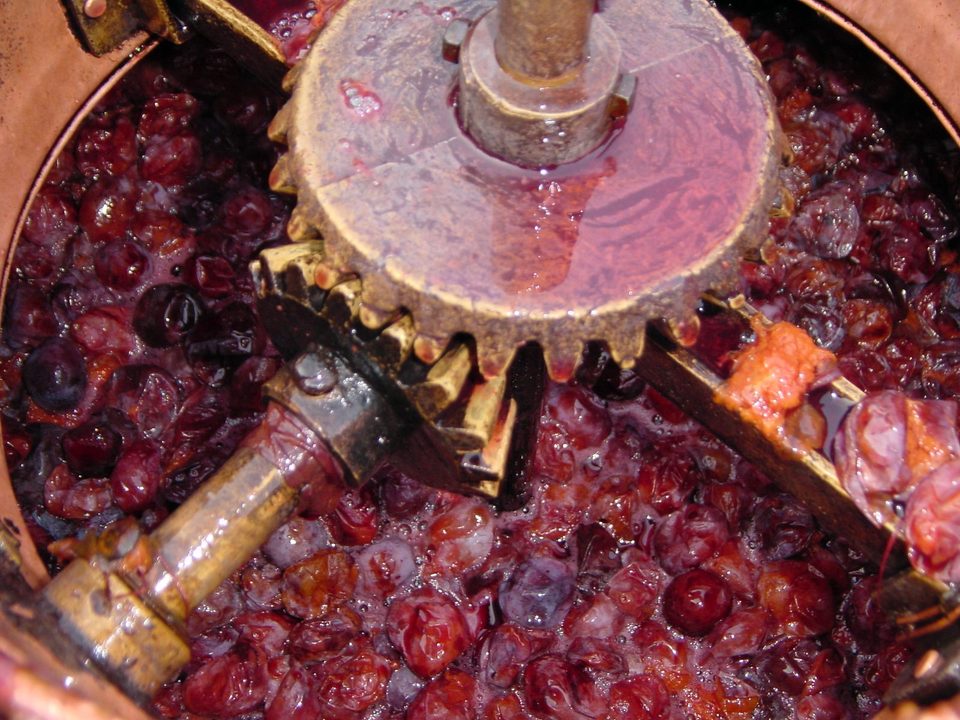
Steeping to make a friendly fruit liqueur is all very well, but distilling plums is what gets us the more popular stronger drinks. Distilling has a long history as we learned in Water, Sweat and Burns, and fruit is a common starting point (alongside grains for whisky and vodka, sugar cane for rum and agave for tequila and mezcal). Can you guess what the most common fruit is to distil? No, not plums or damsons (trick question!). It is of course the grape. By far and away the most popular, making Cognac, Armagnac, Italian grappa, South American pisco and Turkish rakı. However, I was surprised to see that plums are comfortably in second place2, well ahead of apples (used for Calvados in Normandy, and the apple and pear Obstler of Germany and Austria), and apples in turn are much more popular than pears, cherries or apricots. I’d like to think the popularity of plums stems from our longstanding relationship since Mesolithic times. But it could also be that low maintenance plum trees are happy in the cooler hills of central Europe and the Balkans, where vines struggle, the plums ferment easily, and when there’s a glut of fruit the distillation produces a long lasting and tasty product.
Nobody knows exactly when plums first went into a still, but the best guess is the 15th or 16th century. In the Ottoman Balkans, brandy turns up in a customs law for Vidin, on the Danube in today’s Bulgaria, in 1586, and by 1604 stills were being taxed near Banja Luka in Bosnia. The Belgrade historian Jelena Mrgić thinks the weather played its part. The Little Ice Age, a long cold spell from about the 14th to the 19th century, was hard on Bosnia’s vineyards, and plums coped much better with the cold and the wet. In Lorraine, in north-east France, phylloxera wiped out the vineyards from 1882, and French families who had left the Moselle when Germany annexed it in 1871 planted the mirabelle trees they knew from home.
Rakia or rakija is the common name for fruit spirits across the Balkans, and those based on plums are the most common in many countries. Slivovitz (šljivovica) means “plum spirit”, from the Slavic word for plum (šljiva, sliva). In Serbia, plum rakia is so dominant that the two words rakija and šljivovica are almost interchangeable.
Plum brandies are mostly drunk neat, as a small measure at room temperature. You can drink them young and clear, or aged in wooden barrels, sometimes for up to 20 years, with the older ones often kept for after a meal. Difford’s tasting notes for an unaged Croatian šljivovica find “pungent, ripe plums” and “peppery spirity spice”. At the other end, Emperus’s 12-year-old won gold at this year’s Belgrade Rakija Fest. Its maker describes flavours of “dried plums and figs” with vanilla, oak and “a faint hint of almond”.
Plenty of plum brandy is rougher than these appealing descriptions suggest, especially the home-made kind: intensely strong, petrol-like fumes and a definite burn down the throat. As travel writer Samuel Patterson wrote: “more gasoline than fruit, the stomach fire less warming than temporarily nauseating”. No less an authority than the Dubrovnik In Your Pocket city guide suggests rakija is also “the ideal way to clean your windows”, especially with a scrunched up sheet of old newspaper. Choose your poison carefully!
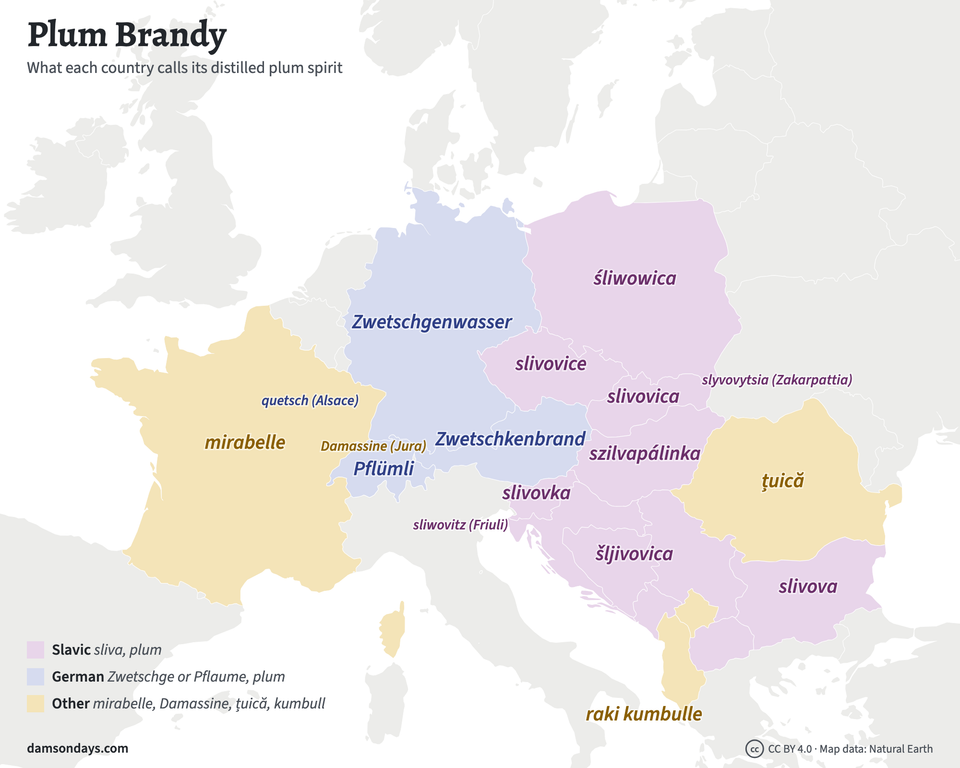
Despite the mixed reviews, there’s a plum brandy in most countries in Europe, as you’ll see from the map:
Growing it and drinking it
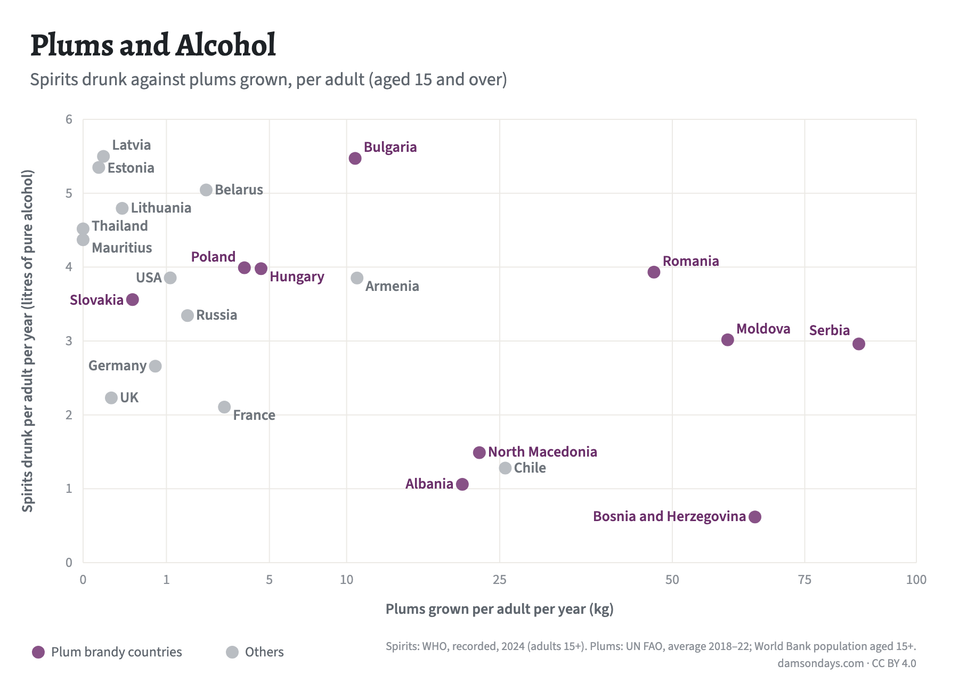
Although everyone’s got their own plum brandy, some countries have a lot more plums to make it from, and not necessarily the ones you’d expect. If we look at it on a per-adult basis, Serbia grows the most plums of any country globally, a whopping 87kg per adult per year3. Per adult, the top of the list is dominated by the Balkans and their neighbours:
- Serbia: 87kg of plums produced per adult per year
- Bosnia and Herzegovina: 65kg
- Moldova: 60kg
- Romania: 47kg
- Chile: 26kg
- North Macedonia: 23kg
- Albania: 21kg
- Armenia: 11kg
- Bulgaria: 11kg
In total, China grows by far the most plums, about 6.8M tonnes a year and more than half the world’s crop, but that’s only 6kg per adult. The UK grows a measly two plums per adult a year, though that misses all the garden trees. Chile is the odd one out. It dries almost 90% of its plums as prunes and sells the rest fresh, so it makes almost no plum brandy.
Does this mean these countries also drink the most? The next chart shows two things: how many plums a country grows (per adult in their population, in kg per year), and how many litres of pure alcohol spirits an adult drinks on average per year. A litre of 100% alcohol isn’t actually drinkable, but that’s just a way to standardise the measure. If you drink 6 or 7 750ml bottles of gin a year, that’s about the same as 2 litres of pure alcohol, which puts you at the UK average. That may seem like a lot, but think of the poor Latvians and Estonians who drink nearly three times that. If you’re wondering how on earth anyone knows how much spirit everyone drinks by the way, it turns out the World Health Organization works it out from what each country makes, imports and exports, checked against sales and tax records, and then divides it by the number of adults in the country.
Vodka, whisky, gin and rum are drunk all over the world, many of them made by big multinationals. In the plum countries, a local drink made by small distillers and in back yards holds its own against them. In Serbia, plum brandy dominates. 70% of its mountainous plum harvest goes to making rakija, and it may be even higher in Romania. Serbia makes 50 to 60 million litres of rakija a year, about 7 litres for every person4. For other countries on the chart, it’ll be other spirits, like vodka in the Baltics and Russia, or whisky in France, which gets through more than 100 million bottles a year.
The result of this analysis is that the plum brandy producing countries don’t really drink an unusual amount. Apart from the hard drinking Bulgarians (most of whose rakia is made from grapes) they’re mostly in the middle of the pack (albeit the pack in this case includes the top 10 spirit drinking countries in the world5, so they’re not slouching!).
Bosnia is harder to explain. It grows the second most plums per adult in the world, but records less than a litre of spirits per adult, under a third of Serbia’s. Part of the answer is that about half of Bosnians are Muslim, and in a 2013 Pew survey only 16% of Bosnian Muslims said drinking was morally acceptable. The rest could well be home distilling that isn’t captured in the official figures. WHO itself estimates that about a fifth of Bosnia’s drinking goes unrecorded.
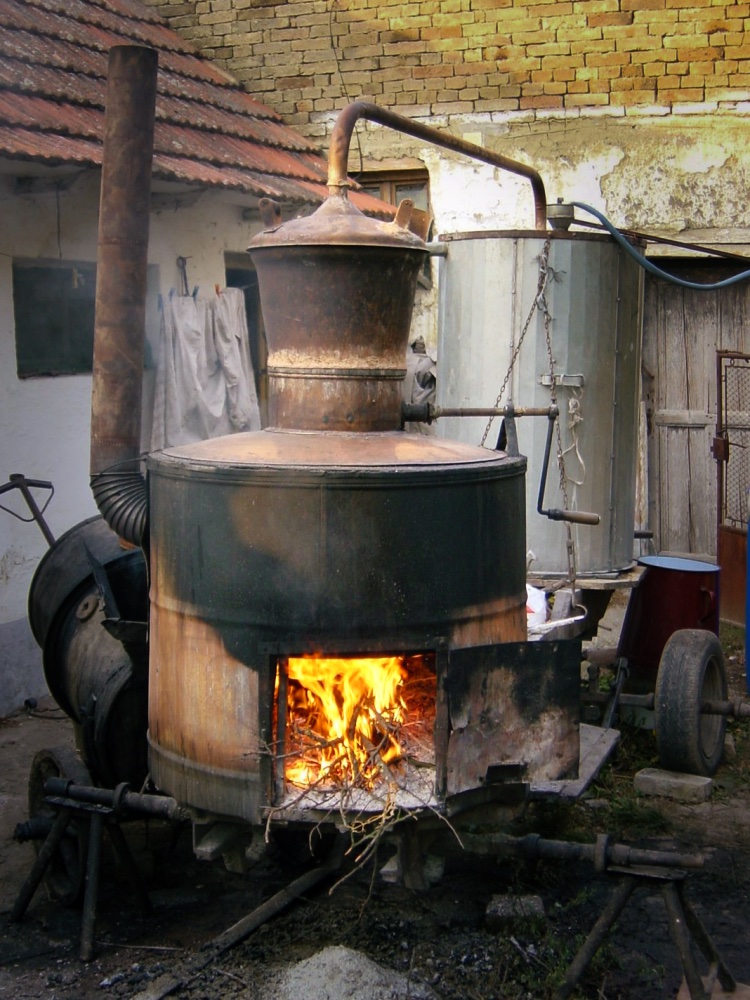
In fact, home distilling is remarkably popular. Serbia makes more than twice as much rakija as its own official statistics say Serbians drink, because most of the rakija produced isn’t sold in the shops. It comes from the vesele mašine, “merry machines”, in people’s back yards, making rakija for themselves and the neighbours. Serbia has about 600 registered distilleries, and tens of thousands of small stills. In 2013 Hungarians made about 26 million litres of pálinka, and only about one bottle in fourteen came from a commercial distillery. The rest was home stills or people taking their own fruit to contract distilleries. Not all of it stays within the rules. In Poland, śliwowica łącka was moonshine until 2012, when a local maker became the first to get a legal permit. In 2017 Bulgarian customs officers seized 2,356 litres of rakia without tax stamps from two monasteries, Troyan and Bachkovo. The monks of both monasteries had ready explanations: Troyan’s rakia was for gifts, not for sale, and Bachkovo’s had been donated. There’s many countries where you can take your own fruit to a distillery and avoid the taxes and duties on your alcohol (for instance your first 50 litres of pure alcohol will be duty free in France, and Romania has a similar allowance).
There’s no such thing in the UK: distilling at home is illegal, and so is taking your plums to a distillery without paying full duty. Perhaps that’s another reason we’re keen on steeping our sloes and damsons in gin instead, and missing out on the fun of home distillation. Nevertheless there are now a few up and coming UK distillers getting in on the plum brandy game, despite it not being a national tradition, and even distilling damsons rather than sweet plums:
- Capreolus Distillery (near Cirencester): damson, plum and greengage eaux-de-vie from fruit grown within 50 miles.
- Pleasant Land Distillery (Kent): damson eau-de-vie from Kentish Farleigh damsons, and a Victoria plum one.
- Greensand Ridge (Kent): a plum brandy billed as an English slivovitz.
Destiny
When I started this article, looking into the cherry plums and damsons in my little London garden, occasionally making liqueurs and amaros, I had no idea I was following in such a long tradition. Ironically, given my Serbian origins, I didn’t know what a powerhouse Serbia was in global plum production, most of it destined for plum brandy. A fruit people have been eating since Mesolithic times, more than 6,000 years ago, turned into a drink that goes back hundreds of years and has spread all over Europe. It seems that having a damson tree predestined me to a life of plums and alcohol!
As an old Serbian belief supposedly puts it:
Gde šljiva napreduje, tu je dobro za gradnju nove kuće.
Where the plum thrives, that’s a good place to build a new house.
Plum brandies country by country
The Balkans
- Serbia: šljivovica, on UNESCO’s intangible heritage list since 2022.
- Croatia, Bosnia and Herzegovina and Montenegro: šljivovica, as in Serbia, though on the Croatian coast grape rakija and herbal travarica are more common.
- Slovenia: slivovka or slivovec.
- Bulgaria: slivova rakia, and the best known is Troyanska slivova rakia. The Troyan Monastery is said to have distilled it since the 14th century.
- Albania and Kosovo: raki kumbulle, made mostly in the colder north and east, such as Kukës and Dibër.
- North Macedonia: slivova rakija, made around Berovo and Kičevo, though grape rakija is more common there.
Central and eastern Europe
- Romania: țuică, from plums. Romania is the EU’s largest plum producer. It’s usually distilled only once, to between 24% and 40%, while the twice-distilled version can reach 50 to 65%. Old țuică is aged in mulberry barrels, which turn it a “pearlescent yellow”, and it’s sipped as a shot before a meal (traditionally every meal!). In Transylvania it’s palincă de prune (palincă on its own is any fruit brandy, like Hungarian pálinka), and in Maramureș and Oaș in the far north it’s horincă or turț.
- Hungary: Szatmári szilvapálinka; pálinka in general can be made from any fruit. Hungarian law sets out how long pálinka has to sit in a wooden cask before it can be called “aged” or “old”, and ágyas (“bedded”) pálinka is rested on fruit. It’s meant to be drunk at room temperature from a tulip-shaped glass that holds in the aroma.
- Slovakia: slivovica.
- Czechia: slivovice.
- Poland: śliwowica łącka, from the hills around Łącko.
- Ukraine: slyvovytsia, home-made in the Zakarpattia region in the far west, where it’s essential at weddings.
German-speaking countries and Italy
- Austria: Zwetschkenbrand.
- Germany: Zwetschgenwasser.
- Switzerland: Pflümli. It goes in Kafi Schnaps, a weak coffee with sugar and a good splash of plum, cherry or pear spirit, drunk at cold outdoor events. The saying goes that a coin at the bottom of the cup should be visible, otherwise there isn’t enough schnapps. In the Jura, in the far north-west, they make Damassine from a small local plum, the damasson rouge (“red damson”). Like damson, its name comes from Damascus, and local legend says crusaders brought the plum back from the Middle East, though there’s no evidence for it.
- Italy: “Sliwovitz del Friuli-Venezia Giulia” is a protected name for spirit from Italian plums distilled in that region.
France
- Quetsch d’Alsace: made from whole fresh quetsch plums (the Alsace name for the Zwetschge) and rested for at least six months.
- Mirabelle de Lorraine eau de vie: a protected geographical indication. Lorraine grows 70% of the world’s mirabelles.
- La Vieille Prune (Louis Roque, Souillac, since 1920): distilled from three varieties, Ente, mirabelle and Reine-Claude.
Footnotes
- Damson came through Middle English, and Zwetschge through a Vulgar Latin form, davascena, and Middle High German tzwetzschken. See Wiktionary: Zwetschge. ↩︎
- Rough yearly figures, in litres of pure alcohol (the alcohol alone, without the water). Grapes: at least 300 million, including about 46 million for Cognac alone. Plums: about 50 to 80 million, mostly Serbian šljivovica (about 18 million, according to N1) and Romanian țuică, and much of it made at home. Apples: about 5 to 15 million, of which Calvados is only about 1.4 million. Nobody counts plum brandy in one place, so the plum figure is pieced together country by country and is only a ballpark. ↩︎
- UN Food and Agriculture Organization figures for plums and sloes, averaged over 2018 to 2022, divided by World Bank population aged 15 and over (the same adults the World Health Organization counts for drinking). ↩︎
- That’s litres of rakija, about 3 litres of pure alcohol. Not all of it gets drunk: the distillers in Slobodan Adžić’s 2023 survey made about two and a half times as much as they sold. The official figure is 2.9 litres of spirits a head, from Serbia’s Statistical Office (2019), as cited by Adžić. The 70% is from Serbia’s Ministry of Agriculture, via Agronews. ↩︎
- Counting only countries with more than a million people. Four small island nations would otherwise make the top 10: the Cook Islands, Saint Lucia, Dominica and Barbados. ↩︎